
होमKabaddiSurjeet Singh Named India Captain, Naveen Kumar Vice-Captain for Commonwealth Kabaddi Championship 2026
Surjeet Singh Named India Captain, Naveen Kumar Vice-Captain for Commonwealth Kabaddi Championship 2026
राष्ट्रमंडल कबड्डी चैंपियनशिप 2026 23-31 अक्टूबर 2026 तक अहमदाबाद में आयोजित होगी। भारतीय पुरुष टीम के कप्तान सुरजीत सिंह और उपकप्तान नवीन कुमार हैं। आयोजन में पुरुष और महिला वर्ग शामिल हैं, लेकिन प्रारूप, पूरा स्क्वॉड, महिला कप्तान, प्रसारक और स्वीकृति निकाय का खुलासा नहीं हुआ है। ईरान राष्ट्रमंडल सदस्य नहीं होने के कारण अनुपस्थित है, जिससे भारत प्रबल दावेदार बनता है। ‘उद्घाटन संस्करण’ और ‘लगातार खिताब’ के दावे में विरोधाभास है।
New Delhi: Surjeet Singh has been appointed captain of the Indian men's kabaddi team for the Commonwealth Kabaddi Championship 2026, with Naveen Kumar as vice-captain. The tournament will be held in Ahmedabad from 23 to 31 October 2026. It is described as the inaugural edition of the championship and will include both men's and women's competitions. India will play at home and will naturally start as the overwhelming favourite. Yet several key details remain undisclosed: the full squad, the tournament format, the number of participating nations, the women's captain and coach, and the sanctioning body.
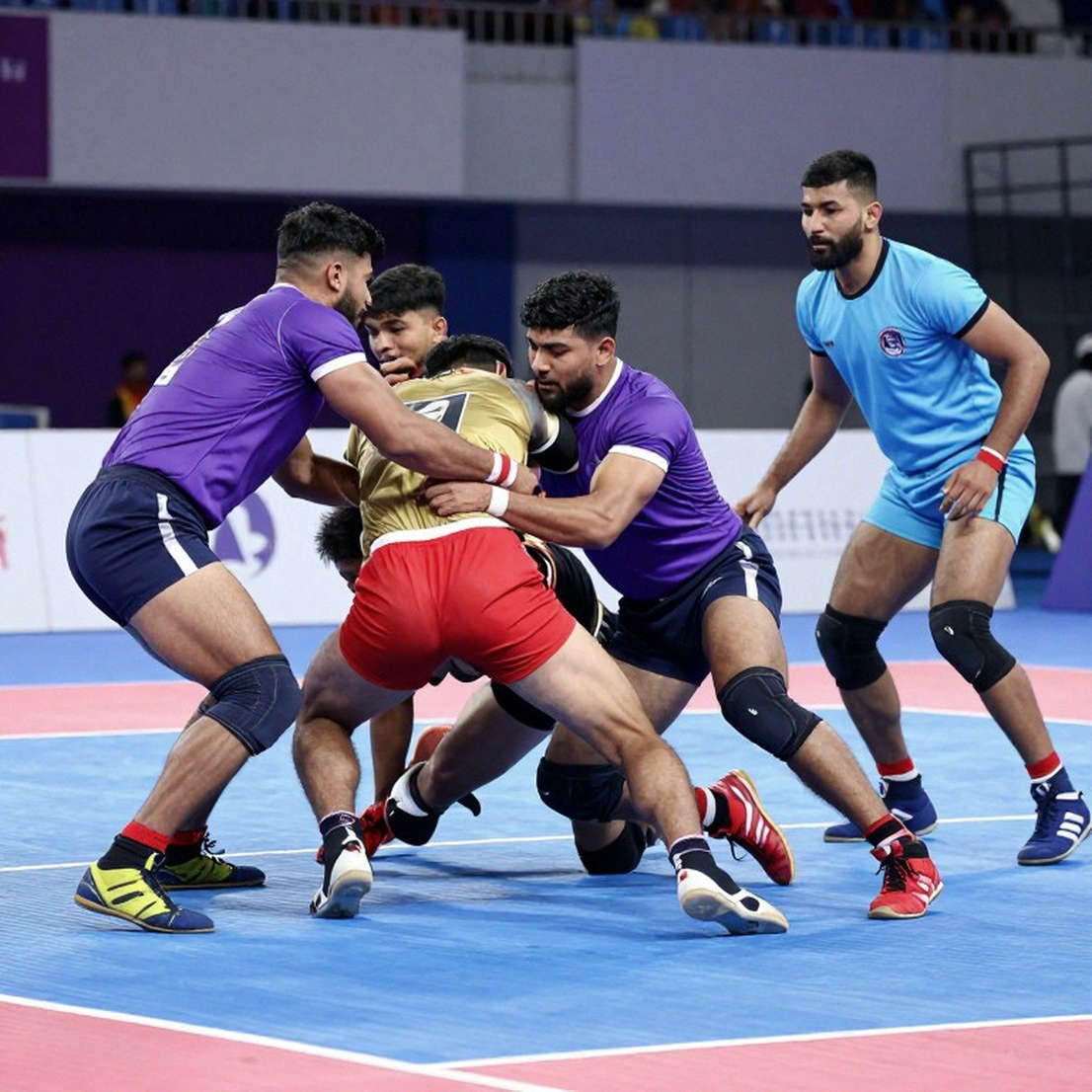
Kabaddi is a seven-a-side contact sport played on a 13m by 10m court. One raider at a time crosses into the opponent's half, touches one or more defenders within a 30-second limit, and must return safely to score. The raider must continuously chant kabaddi-kabaddi; if the chant breaks, the raid is void and the raider is out. Defenders score a tackle point if they stop the raider inside their half. When all players of one side are out, the opposing team earns two bonus points and the eliminated team returns to the mat, known as an All Out. Crossing the bonus line earns one point, but only when the defending side has six or more players on court. After two consecutive empty raids, the third raid becomes a Do-or-Die raid; if it fails, the raider himself is out. A successful tackle against three or fewer defenders is a Super Tackle and is worth two points, while a raid scoring three or more points is a Super Raid.
In kabaddi, captaincy is not merely ceremonial. Play resets every 30 seconds, so the captain's real job is in-court decision-making: when to call a time-out, when to take a Do-or-Die risk, when to concede a point to reset an All Out threat, and how to organise corner-cover alignment in defence. The pairing of Surjeet Singh as captain and Naveen Kumar as vice-captain fits this operational logic. Surjeet is described as bringing defensive experience and team organisation, while Naveen is expected to lead the raiding department.
According to the announcement, Surjeet will organise the team on the mat, maintain defensive discipline, and respond to opponents' attacking threats. This role matters because a defender-captain has the best vantage point during the opposition's raid. He can direct tackle angles, chain-tackle timing, and cover positioning. But there is a practical limit: when India raids, the captain is on the other side of the mat, so his direct control over in-raid decisions is limited. Making the lead raider vice-captain is therefore a sensible balancing move.
Naveen Kumar is the centre of India's raiding department. The statement says his individual raids and quick points can shift momentum. That is a generic claim, but in kabaddi it means Naveen will carry the burden of scoring and pulling the team through pressure situations. In the Pro Kabaddi League, Naveen is known as a high-volume raider and is particularly valued in Do-or-Die situations. However, the report provides no raid points, success rates, or match counts. The same gap applies to the wider team, because naming only two players does not reveal the shape of a probable 12-to-14-member squad.
A defender-captain and raider-vice-captain is a standard PKL template. The logic is clear: the defender-captain sees the whole court during the opposition's raid and can immediately direct the defensive line-up, while the raider-vice-captain controls the tempo and risk management of his team's scoring phases. In kabaddi, dependence on a single raider is a major risk. If Naveen is the only designated lead raider and the second raider is not identified, opponents can target him with chain tackles or corner traps. The obvious question is who the second scoring option will be and what India's raiding plan is if Naveen is tackled out or injured. The announcement gives no clarity on this.
The absence of the tournament format is also significant. It is not stated how many countries will take part, whether there will be a group stage or a straight knockout, or how matches will be scheduled. In a short format, All Out and Do-or-Die swings are more decisive; in a longer round-robin, squad depth and injury management matter more. Without knowing the format, the tactical burden on the captain cannot be properly assessed. Substitution and review rules are also undisclosed. A PKL-style rolling substitution system could change the captaincy calculus, but the report does not say what rules will apply.
There is also a caution over the name Surjeet Singh. It is a common Indian name shared by more than one professional kabaddi player. The announcement does not give his PKL franchise, home state, or specific defensive position—cover, corner, or otherwise. That is a notable reporting gap for a national captaincy announcement, because readers cannot fully anchor the identity. The selection rationale is also not explained beyond general references to experience and defensive organisation.
On competitive balance, the event looks heavily skewed towards India. Kabaddi depth across Commonwealth nations is limited. Bangladesh, Pakistan, Sri Lanka, Malaysia, and Singapore can be placed in the mid-tier challenger bracket, while England, Kenya, Australia, and Canada are development-tier teams. India has Standard Style depth and PKL experience, so it is the natural favourite at home. But that same fact raises questions about the event's prestige. If India has no genuine rival on the mat, the title's value is greater for development than as a competitive benchmark.
The biggest structural fact is that Iran is not a Commonwealth member and will therefore be absent. Iran is the only nation to have broken India's men's Asian Games gold run and is the sport's most established challenger in Standard Style. Without Iran, the championship may carry an international label but could be one-sided competitively. The original report does not mention this, but it is the most important context for judging the tournament's significance.
The Commonwealth frame here is a governance and diplomatic identity, not a natural competitive selection. Kabaddi's strong grassroots base is concentrated in India, Iran, and parts of South Asia. Most Commonwealth countries do not have that depth. A Commonwealth championship therefore gives a platform to countries whose Commonwealth membership is political rather than to those with the strongest kabaddi teams. For India, the event can be a soft-power and sports-export platform, but it should not be read as a measure of kabaddi's global competitive depth. It is also worth noting that kabaddi is not part of the Commonwealth Games programme; it is not included in Glasgow 2026. The word Commonwealth in the title does not make it part of the Commonwealth Games.
The report also contains a clear contradiction. On one hand, it calls the event the inaugural edition, meaning the first edition. On the other, it says India will enter to win back-to-back titles. An inaugural tournament cannot be won back-to-back. It is possible the author conflated separate international titles, or that a previous edition under a similar name existed but was not disclosed. As written, the claim is unreliable and needs clarification.
The calendar also creates complications. The 2026 Asian Games are scheduled for Aichi-Nagoya in Japan from September to early October. Kabaddi has been a medal sport since 2026 and remains a priority national-team target for India. The Commonwealth Championship runs from 23 to 31 October, only about three weeks after the likely end of the Asian Games. In addition, the PKL season has traditionally run around October to December. That could create a player-release conflict between franchises and the national team. It also needs to be clarified whether India will field a full-strength side or an experimental team.
The choice of Ahmedabad as host is also a signal. Gujarat is not a traditional kabaddi talent heartland in the way Haryana, Maharashtra, Punjab, Uttar Pradesh, and Tamil Nadu are. But Ahmedabad is a major sports market with a PKL franchise presence and strong state-level infrastructure. Hosting the inaugural international championship there looks more like a market-expansion decision than a talent-development one. It may help build a new audience, but Gujarat's kabaddi depth is thinner than that of the core states.
The women's competition is the most positive and also the most incomplete part of the report. The event is said to include a women's draw, but no women's captain, squad, coach, format, or opponent nations are named. Four or five detailed points are given to the men's captaincy, while the women's section gets one line. This asymmetry reflects the priorities of the Indian kabaddi media ecosystem. A women's international platform is important in itself because the PKL has no parallel women's league. If the event gives women players regular international matches, that could be the championship's most concrete structural contribution.
The commercial and media picture is also incomplete. No broadcaster, sponsor, prize money, or player fee is named. A national captaincy announcement is a standard news peg in Indian media, so domestic pickup is likely. But international rights value outside the Indian diaspora will be near zero. The event's prestige will also depend on who sanctions it—the IKF, a Commonwealth kabaddi body, or the Indian federation. The absence of that detail is a serious gap. Without a broadcaster and sanctioning authority, the event's commercial potential cannot be assessed.
At the technical level, language also needs care. In kabaddi, raiding is sometimes translated generically as attacking, which loses the raider-specific meaning. The difference between Standard Style and Circle Style is also not clarified. A national-team event in Ahmedabad is likely to follow Standard Style, but the report does not say so. It also does not mention whether rule revisions apply for the new event. These may seem like small points, but they matter for understanding the captain's role, the raider's value, and the defensive plan.
Overall, the appointments of Surjeet Singh and Naveen Kumar do create a logical structure—defensive experience with the captain, raiding edge with the vice-captain. But the announcement does not give the full picture until the squad, format, women's leadership, sanctioning body, and broadcast arrangements are known. For India, this tournament could be a chance to win a title at home, but its real value will depend on whether it gives kabaddi new competitive depth or remains another India-centric event. For now, the captaincy announcement is only the starting point; the bigger questions remain unanswered.
संबंधित खिलाड़ी
अनुशंसित
India vs Uganda: The 46–26 Scoreline Is Clean — the 'Commonwealth' Tag Is Not2026-10-25
Commonwealth Kabaddi Championship 2026, Day 1: The Table Adds Up, the Story Does Not2026-10-25
Day One in Ahmedabad: The Table Adds Up, the Picture Doesn't2026-10-25
The Auction Sheet Says One Thing, the Filing Says Another: A Page-47 Audit of the Kabaddi Transfer Window2026-10-24
46 and 45: The Two Scores That Reveal India's Win Is a Weak-Table Story2026-10-25
The 26 Matters More Than the 46: Reading the Commonwealth Kabaddi Championship Before India vs Uganda2026-10-25
अनुशंसित
India vs Uganda, Match 9: The Third Line Says More Than the 46-26 and 45-29 Scoreboards2026-10-25
Iran Is Co-Favourite, Not an Upset: The Selection Ledger, the Auction Clock and the Three Numbers That Rewrite India's Kabaddi Story2026-10-27
Commonwealth Kabaddi 2026, Day 1: The Score-Difference Rule Is Ranking Teams That Haven't Raided Yet2026-10-25
46 and 45: The Two Scores That Reveal India's Win Is a Weak-Table Story2026-10-25
Kabaddi's Fast Scoreboard and the Three Ledgers Beneath It2026-10-25
Commonwealth Kabaddi Championship 2026, Day 1: The Table Adds Up, the Story Does Not2026-10-25
अनुशंसित
Day One in Ahmedabad: The Table Adds Up, the Picture Doesn't2026-10-25
Commonwealth Kabaddi Championship 2026: India vs England — A Test of Rotation, Not Victory2026-10-25
The Auction Sheet Says One Thing, the Filing Says Another: A Page-47 Audit of the Kabaddi Transfer Window2026-10-24
India vs Uganda: The 46–26 Scoreline Is Clean — the 'Commonwealth' Tag Is Not2026-10-25
India vs Uganda, Match 9: The Third Line Says More Than the 46-26 and 45-29 Scoreboards2026-10-25
Commonwealth Kabaddi Championship 2026, Match 4: In Ahmedabad, India vs England Will Measure the Field, Not India2026-10-28